



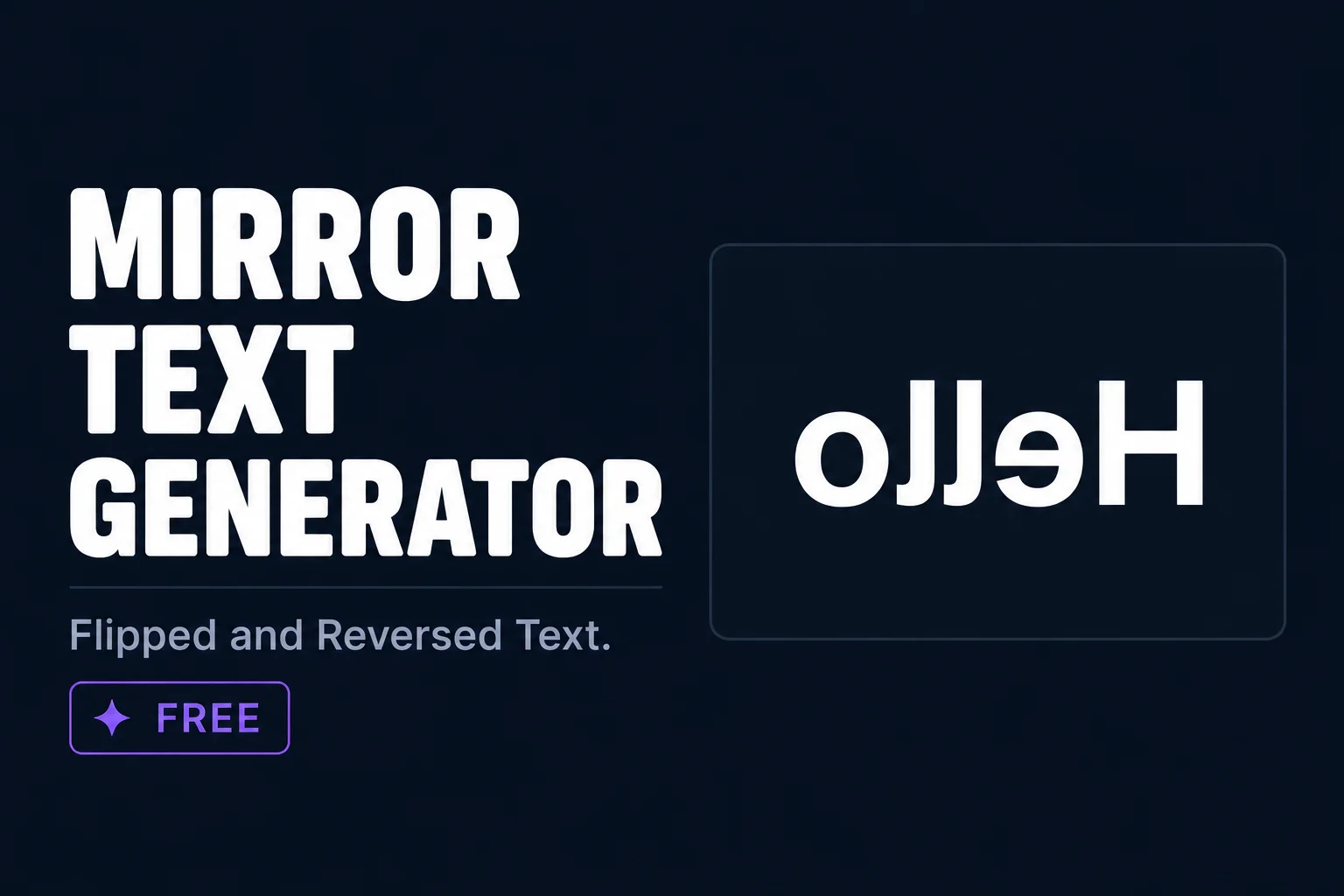
Quick answer: A mirror text generator flips your text horizontally using Unicode mirrored character equivalents. Creates a unique visual effect for creative captions, Discord, and dark aesthetic profiles. Free and copy paste ready.
Mirror text flips each letter to create a horizontally reversed version of your text. It is a creative and eye-catching effect used in dark aesthetic profiles, art accounts, and Discord servers. TextChic gives you mirror and reverse text styles, all free to copy in one tap.
What is mirror text?
Mirror text uses Unicode characters that are horizontally flipped versions of standard letters. Not every letter has a perfect Unicode mirror equivalent, so some characters use the closest visual match available. The result is text that appears flipped or reflected, like text seen in a mirror.
How to generate mirror text
- Type your text aboveEnter any word or short phrase.
- Find the mirror styleLook for the flipped text in the output.
- Copy in one tapHit copy next to the mirror style.
- Paste anywhereWorks on Discord, Instagram captions, and dark aesthetic profiles.
How mirror text actually works
Mirror text takes your input and flips it in two ways: the character order is reversed so the last character comes first, and individual characters are substituted with their Unicode mirror equivalents where available. The result looks like text viewed in a physical mirror — laterally inverted from left to right.
The Unicode standard includes mirrored versions of many Latin characters in various blocks. For example, the mirrored equivalent of a lowercase ‘b’ looks like a ‘d’ flipped horizontally. Not every character has a perfect Unicode mirror equivalent, so mirror text generators use the best available approximations for each letter, producing text that reads as convincingly mirrored even where the Unicode coverage is imperfect.
This is different from simple reverse text, which only reorders characters without flipping them. Mirror text combines reversal with character substitution to create the most convincing reflected text effect possible using standard Unicode characters.
Mirror text versus reverse text — what is the difference
The distinction between mirror text and reverse text matters depending on your use case:
- Reverse text — Reorders characters only. “Hello” becomes “olleH”. Same characters, opposite order. Readable if you consciously decode it. Works everywhere because it uses standard characters.
- Mirror text — Reverses character order AND substitutes characters with flipped Unicode equivalents. The result looks visually reflected, not just reordered. Requires Unicode character availability on the viewing platform.
- Upside down text — A related effect that rotates characters 180 degrees using Unicode equivalents. Combines flipping in both axes. Covered by a separate TextChic generator.
For most creative and social media use cases, mirror text creates a more visually striking effect than simple reverse text. For platform compatibility and puzzle use cases where you want the text to be decodable, reverse text is the more reliable choice.
Best platforms and use cases for mirror text
- Instagram captions and Stories — Mirror text in a caption creates an immediate visual puzzle that stops users scrolling. The reflected appearance is distinctive enough to earn a second look even in a dense feed.
- Twitter/X posts — Used for mystery posts, riddles, or reveals. Mirror text in a tweet creates intrigue that drives replies and quote-tweets from users trying to decode it.
- Discord usernames and bios — Mirror styled display names are memorable and distinctive. In servers with hundreds of members, a mirrored username is immediately recognisable.
- TikTok video text overlays — Copy mirror text into TikTok captions or on-screen text in the app for visual interest that performs well in the native text overlay tool.
- Creative writing and art projects — Writers and visual artists use mirror text for cover pages, title designs, and conceptual text art where the reflected effect carries thematic meaning.
- Brand and profile identity — Some creators use mirrored versions of their name as a signature element across their content, creating a visual identifier that is distinctive and ownable.
Mirror text for content engagement
Mirror text is one of the most consistently high-engagement Unicode text effects because it creates genuine curiosity. When a viewer encounters mirrored text in a feed, they automatically try to decode it. That cognitive effort creates a moment of active engagement rather than passive scrolling, which increases the time a person spends on your content.
The most effective use of mirror text in content strategy is the reveal format. Post mirror text as the setup of a joke, question, or statement. Let viewers decode it. The decoding process itself becomes the interaction. Replies and comments from people sharing what they read confirm their participation and extend the post’s reach organically.
Used in profile bios, mirror text creates a memorable identity element that visitors genuinely notice. A bio where your name or a key phrase appears in mirror text is more likely to be remembered and mentioned to others than a standard bio. That word-of-mouth quality is a meaningful advantage in audience building.
Mirror text in design and visual art
Beyond social media, mirror text has legitimate applications in design and visual art contexts. Symmetrical text designs use mirrored text to create typographic balance that is visually satisfying and compositionally clean. Cover art, poster design, and branded content use mirrored text as a compositional element rather than just an effect.
For content creators who produce visual content, copying mirror text from TextChic into Canva, Adobe Express, or Instagram’s own text tool creates a quick way to achieve a typographic mirror effect without needing design software with flipping features. The Unicode characters paste directly into design tool text fields and render as intended.
Limitations of Unicode mirror text
Mirror text has one practical limitation worth knowing: not every character has a perfect Unicode mirror equivalent. Common Latin letters have reasonable approximations, but less common characters, numbers, and punctuation marks may not flip convincingly. The result still reads as mirrored in context, but individual characters may look more like creative substitutions than true reflections.
For situations where you need a photorealistic mirror effect — for print design or high-resolution visual work — Unicode mirror text is a starting point rather than a finished product. For social media captions, bios, usernames, and platform text fields, the Unicode approximation is more than convincing enough for the intended visual effect.
Frequently asked questions
What is mirror text?
Mirror text uses Unicode characters that are horizontally flipped versions of standard letters, creating text that looks reflected or reversed like in a mirror.
Does mirror text work on all platforms?
Yes. Mirror text uses standard Unicode characters that work on any platform supporting Unicode text including Instagram, Discord, and WhatsApp.
Is the mirror text generator free?
Yes. TextChic is completely free with no account or registration needed.
Does mirror text work on all social media platforms?
Mirror text works on most major platforms including Instagram, Twitter/X, TikTok, Discord, WhatsApp, and Telegram because it uses standard Unicode characters. Some individual mirror-substitute characters may render differently on older operating systems or non-standard fonts, but the overall mirrored appearance comes through correctly on all modern devices and platforms.
What is the difference between mirror text and upside down text?
Mirror text flips characters horizontally (left to right, like a physical mirror). Upside down text rotates characters 180 degrees so they appear flipped vertically. Both use Unicode character substitutions. Mirror text creates a laterally reflected effect. Upside down text creates a rotated effect. TextChic has separate generators for each effect.
Can mirror text be used in a gaming username?
Yes, on platforms that accept Unicode characters in usernames. Discord, Twitter, and most social platforms support it. For in-game names in PUBG, Free Fire, or Minecraft, compatibility depends on the game. Paste your mirror text into the name field and check the preview before confirming. Not all games render all Unicode substitution characters correctly.
